4x4 parity: why it happens and how to solve it
Why OLL and PLL parity appear on a 4x4, how they differ from normal 3x3 cases, and which formulas to use.

What parity is
On a 3x3 some positions are impossible: one edge cannot be flipped alone, and two pieces cannot be swapped alone. On a 4x4 both appear — and they are not a mistake.
The reason is the cube’s structure: a 4x4 “edge” is two independent pieces (wings) that can swap halves.
Two parities
| Parity | Symptom | Formula |
|---|---|---|
| OLL | The last-layer cross will not form — one edge is flipped | Rw U2 x Rw U2 Rw U2 Rw' U2 Lw U2 Rw' U2 Rw U2 Rw' U2 Rw' |
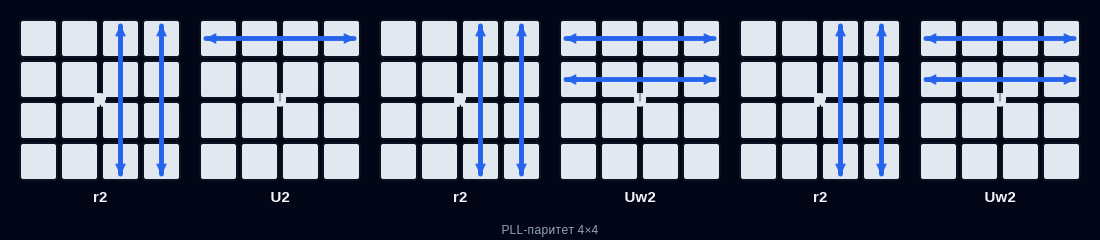
| PLL | Cross and corners correct, two edges swapped | r2 U2 r2 Uw2 r2 Uw2 |
OLL parity
You build the cross and one edge stays wrong: its yellow sticker faces sideways. No 3x3 algorithm can fix this, because the state does not exist on a 3x3.
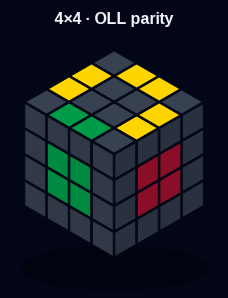
Apply the formula, then continue as usual.

PLL parity
Everything looks solved except two last-layer edges, which are swapped. The short formula swaps two dedges:
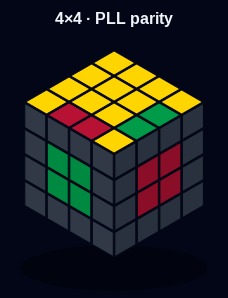
r2 U2 r2 Uw2 r2 Uw2Then finish with normal PLL or the beginner method.
Why 5x5 has no parity
Odd cubes (5x5, 7x7) have fixed centres and a single middle edge piece, so the parity states cannot occur. If something looks like parity on a 5x5, it is an edge-pairing mistake.
When to use them
- Only on even cubes. 4x4 and 6x6.
- Only at the last layer. Fix parity after reduction, not before.
- Check first. A swapped pair may also mean the cube was reassembled wrong.
Common mistakes
- Applying parity too early. It is a last-layer fix.
- Mixing up the two formulas. OLL fixes a flipped edge; PLL swaps two edges.
- Forgetting the wide turns.
RwandLware two layers, not one.
Mini FAQ
Is parity a defect? No, it is a property of even cubes.
Can I avoid it? You can influence the edge pairing, but not reliably.
Do I need it on 3x3? No.
Next: how to solve a 4x4.
Related articles

10 algorithms a beginner actually needs
The minimum set of formulas for a 3x3 solve: pif-paf, Sune, the middle-layer and last-layer algorithms — and why each one is needed.

How to read algorithms: notation without confusion
A plain explanation of cube notation: what letters, primes and doubles mean, how to read wide turns and slices, and how not to mix up R and R'.

How to memorise algorithms (and keep them)
Practical ways to learn cubing algorithms: blocks, meaning, associations, spaced repetition and using them in real solves.