CFOP: Cross
How to plan and solve the cross in CFOP: inspection, planning the first moves, choosing the colour, and the mistakes that cost seconds later.
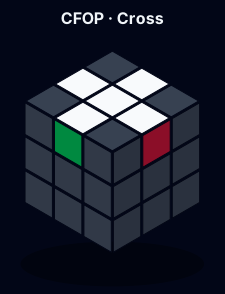
What the cross is
The cross is four edges around one centre, solved at the bottom. In CFOP it is the only intuitive step: there are no algorithms, only planning and practice.
Most cubers solve the cross on white, but any colour works. Pick one and stay with it — colour neutrality is an advanced skill.
The goal
- Four edges with the same colour (white) form a plus on the bottom.
- Each edge’s side colour matches the centre of that face.
- The cross is solved with white down, so the last layer is always on top.
Planning during inspection
You get 15 seconds of inspection. Good cubers spend most of it on the cross.
- Find the four white edges.
- Work out the solution in your head, move by move.
- Track the first pair. After the cross you want an easy F2L pair; knowing where one is saves a pause.
- Check the last move. The cross should finish with the cube in a comfortable grip.
A cross takes 6–8 moves for most scrambles. If your solution needs 12, there is almost always a better order.
Techniques
| Technique | What it does |
|---|---|
| Daisy | Put four white edges around the yellow centre, then drop them one by one |
| Direct solving | Place each edge straight into the bottom layer |
| Preserving | Keep already placed edges while inserting the next one with a face turn |
| x-cross | Build the cross plus one F2L pair during inspection |
The daisy is slower but reliable. Direct solving is what you want after a few weeks.
Practising
Solve only the cross for a while:
- Scramble.
- Solve the cross slowly, narrating each move.
- Repeat ten times.
Then add a timer for the cross alone: sub-2 seconds is a good target.
Common mistakes
- Side colours do not match. A cross with swapped sides breaks F2L: pairs will not fit.
- Too many moves. Look for a solution that uses already-placed edges.
- Starting F2L without a plan. Pausing after the cross costs more time than a faster cross.
- Changing colour every solve. It prevents pattern recognition.
Mini FAQ
Do I need to be colour neutral? No. One colour is enough until you are fast with it.
How many moves should the cross take? Six to eight on average.
Can I solve the cross on top? You can, but the first layer is easier with white down.
Next: F2L.