Blindfolded solving
How blindfolded cubing works: memorising the cube as letters, executing with M2 and Old Pochmann, and training memory safely.
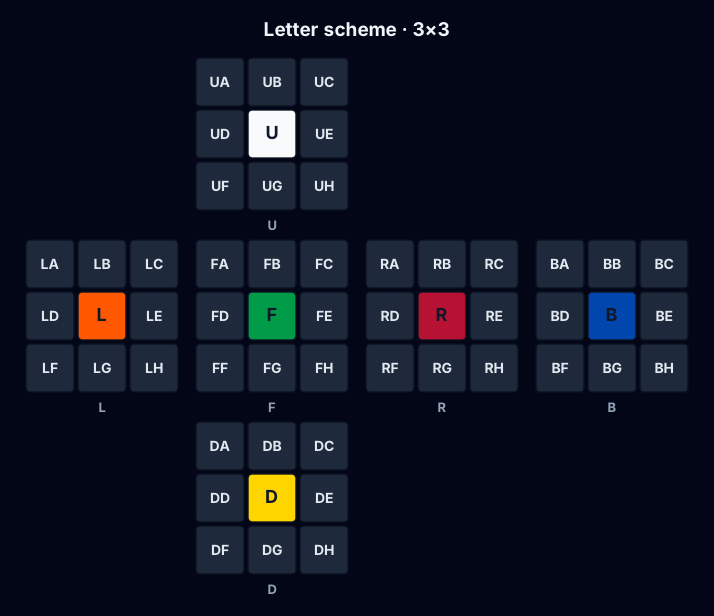
How it works
Blindfolded solving is two separate skills:
- Memo — turn the cube’s state into a sequence you can remember.
- Execution — apply that sequence without looking.
You may inspect the cube before the blindfold goes on. After that, everything is memory.
Memo: letters
Each sticker gets a letter (A–X, 24 stickers). A solve becomes a string of letters, which you group into pairs and turn into words or images:
AB CD EF → “A BoaD, a CD, an EFl” — whatever you can recall.
Good memo uses:
- Pairs (2 letters per image).
- A memory palace: place images along a familiar route.
- Audio loop: repeat the last pair until execution starts.
Execution: the two beginner systems
| System | What it does | Difficulty |
|---|---|---|
| M2 | Solves edges with M-slice setups | medium |
| Old Pochmann | One algorithm for every piece | easy |
| 3-style | Direct commutators | advanced |
Most people start with Old Pochmann for both edges and corners, then move to M2 for edges.
The buffer concept
One piece is the buffer: you take it out, send it where it belongs, and the piece that arrives becomes the new buffer. You repeat until everything is solved.
Training order
- Learn the letter scheme.
- Solve edges only, eyes open, using the algorithm.
- Edges blindfolded.
- Corners blindfolded.
- Full solve with memo.
- Reduce memo time.
Safety and habits
- Never rush memo. A wrong pair costs the whole solve.
- Check parity. If you have an odd number of swaps, you need a parity fix.
- Practise in short sessions. Memory fatigue is real.
- Use a consistent letter scheme — changing it resets your progress.
Common mistakes
- Memorising stickers, not pieces. Pieces move together; learn the cycles.
- Skipping the parity check. It is the most common DNF cause.
- Too much speed in execution. Smooth beats fast until the algorithm is automatic.
Mini FAQ
How long does a first blind solve take? 10–20 minutes including memo.
Do I need a special cube? No, but a quiet, broken-in cube helps.
Is blindfolded dangerous for memory? No — it is a trained skill like any other.
Next: Progress plan.