CFOP: F2L
First Two Layers in CFOP: solving pairs intuitively, the three basic cases, key triggers, and how to practise without memorising 41 algorithms.
Inserting an F2L pair
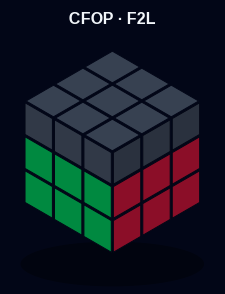
Why F2L matters
F2L solves the first two layers pair by pair: a corner and its edge go in together. That replaces the beginner’s two separate steps and saves dozens of moves.
There are 41 cases, but you do not memorise them. F2L is learned intuitively: you understand where the pair is and how to bring it together.
The idea of a pair
A pair is the corner white-green-red and the edge green-red. The pair is solved when both sit between the white, green and red centres.
F2L works in three moves:
- Find the corner and the edge.
- Join them in the top layer.
- Insert the pair.
The three basic cases
| Case | How to hold | Formula |
|---|---|---|
| Corner above its slot, edge on top, white facing sideways | Corner front-right | R U R' |
| Edge and corner adjacent, pair ready | Pair at front-right | U R U' R' |
| Pair formed but flipped | Pair at front-right | R U' R' |
These three cover most situations; every other case reduces to one of them.

R U R' — insert the pair
F' U' F — insert from the frontTriggers you will use constantly
| Trigger | Effect |
|---|---|
R U R' | Insert right |
R U' R' | Extract right |
R' U' R | Insert left |
F' U' F | Insert from the front |
R U R' U' | Pif-paf, universal setup |
How to practise
- Slow solves, no timer. Narrate: “corner here, edge there, join, insert”.
- One slot at a time. Solve F2L only for the front-right slot, then move the cube.
- Look ahead. While inserting a pair, find the next corner.
- Count moves. A pair should take 8–10 moves, not 20.
Common mistakes
- Rotating the whole cube instead of turning U. Re-gripping hides the next pair.
- Inserting before pairing. A pair that is not joined needs extra moves.
- Ignoring the back slots. Leaving a back slot empty forces awkward work later.
- Memorising cases too early. Understand the pair first.
Mini FAQ
Do I need all 41 algorithms? No. Learn the three basic cases and let the rest follow.
How long does F2L take to learn? Two to four weeks of daily practice for the intuitive version.
Is F2L slower at first? Yes — for a week or two. Then it overtakes the beginner method.
Next: OLL.