Finger tricks
How to turn the cube fast without lifting your hands: basic triggers, finger placement, and drills that build speed safely.
Why finger tricks matter
Most beginners turn the cube with the whole hand. That caps speed at roughly one turn per second. Finger tricks use small, repeatable movements of individual fingers, which is how solvers reach 5–10 turns per second.
The basic triggers
| Trigger | Fingers |
|---|---|
R U R' U' | Right index for U, right ring for R |
R U' R' | Right index flicks back |
R' F R F' | Sledgehammer |
M2 | Middle finger pair, both directions |
Practise each trigger until it feels like one movement, not four.
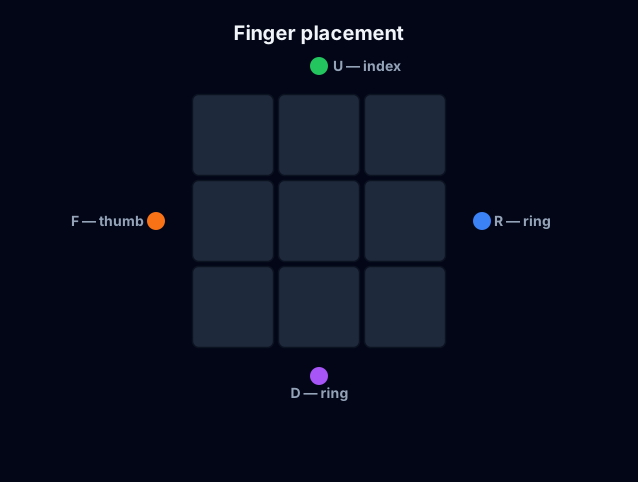
Finger placement
- U — right index finger, flick from the front edge.
- U’ — left index finger.
- R — right ring or little finger, pull down.
- R’ — right index, push up.
- F — left thumb, push.
- D — left ring finger.
Keep the cube steady with the other hand; the wrist should barely move.
Drills
- Single trigger, 20 reps. Then switch hands.
- Trigger chains:
R U R' U'× 6 without stopping. - Slow solves: focus on clean turns, not speed.
- Metronome: one turn per beat, then increase.
Common mistakes
- Whole-hand turns. They feel fast but cap your speed.
- Lifting the cube. Keep it on the table while drilling.
- Gripping hard. Tension kills finger speed.
- Skipping slow practice. Accuracy first, speed second.
Mini FAQ
Do I need a special cube? A magnetic cube helps, but finger tricks work on any decent cube.
How long until it feels natural? Two to four weeks of short daily drills.
Can finger tricks cause injury? Only with excessive volume; warm up and take breaks.
Next: Progress plan and CFOP.