How to solve a Megaminx
Megaminx guide: the star, first two layers like a 3x3, last-layer edges and corners, and why it is easier than it looks.
🟡 Средний
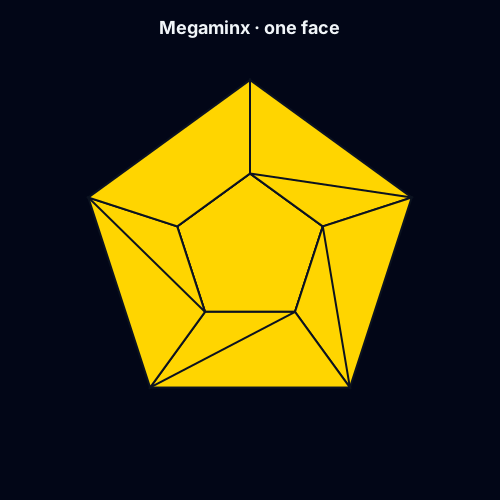
What a Megaminx is
A Megaminx is a dodecahedron: 12 pentagonal faces, 30 edges, 20 corners. It turns like a 3×3 but with more faces.
The good news: the method is a 3×3 method, applied layer by layer.
The stages
- Star — five edges around one centre.
- First two layers — corners and edges, face by face.
- Last layer edges — orient, then permute.
- Last layer corners — orient, then permute.
Stage 1. The star
- Pick a face and build a star of five edges around its centre.
- Match each edge’s side colour to the adjacent centre.
- The result looks like a 3×3 cross with five arms.
Stage 2. First two layers
Insert corners and edges around each of the five sides, exactly like F2L but one face at a time:
- insert a corner with
R U R'style moves, - insert an edge with the same idea,
- rotate the puzzle to work around the star.
Stage 3. Last layer
The last face is a pentagon with five edges and five corners.
| Step | What to do |
|---|---|
| Orient edges | The 3×3 cross algorithm works: F R U R' U' F' |
| Permute edges | Cycle three edges with R U' R U R U R U' R' U' R2 |
| Orient corners | R U R' U R U2 R' (Sune) |
| Permute corners | Three-cycle, as on 3×3 |
Why it is easier than it looks
- No new algorithms: everything transfers from 3×3.
- No parity: the Megaminx behaves like an odd puzzle.
- Plenty of time: moves are slower, but the logic is familiar.
Common mistakes
- Building the star without side colours. The star must match five centres.
- Rushing the last layer. Five edges and five corners take more moves than four.
- Rotating the puzzle mid-algorithm. Keep the grip.
How long it takes
- First solve: 30–60 minutes.
- After practice: 4–8 minutes.
Mini FAQ
Do I need a Megaminx-specific method? No, 3×3 knowledge is enough.
Is it a WCA event? Yes.
Is it harder than 5×5? Comparable; the Megaminx is longer but simpler.
Other puzzles
How to solve a 3×3 Rubik's Cube Beginner method in 7 steps: from a scrambled cube to your first solve, with formulas, diagrams, troubleshooting and a practice plan. How to solve a 2×2 Rubik's Cube A simple 2x2 method: solve the first layer, orient the last layer with one algorithm and permute the corners with two more. How to solve a 4×4 Rubik's Cube A detailed 4×4 guide: building centres, pairing edges, reducing to 3×3, and both parities with formulas. Plus why each stage works. How to solve a 5×5 Rubik's Cube A 5x5 guide: 3x3 centres, pairing three-piece edges, the last two edges and the reduction to a 3x3. No parity on odd cubes.