Petrus method
Building a 2x2x2 block, expanding to 2x2x3, fixing edges and finishing the last layer. The method that introduced block building to speedcubing.
🟡 Средний
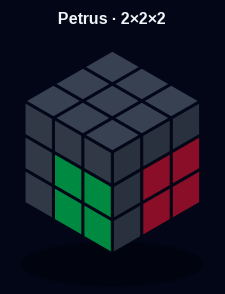
The idea
Petrus builds the cube from a corner: a 2×2×2 block first, then a 2×2×3, then the remaining edges are oriented and the last layer is finished.
It was one of the first methods to show that block building can beat layer-by-layer, and it remains a good way to learn intuitive solving.
The stages
| Stage | What it does |
|---|---|
| 1. 2×2×2 block | One corner block, fully solved |
| 2. 2×2×3 block | Extend it by one layer |
| 3. Edge orientation | Orient the remaining edges (one algorithm) |
| 4. Finish two layers | Place the remaining edges and corners |
| 5. Last layer | Corners and edges with a small algorithm set |
Only about 10–15 algorithms are needed for the whole solve.
Why Petrus is good for learning
- Blocks are intuitive. You learn how pieces move, not how to recall.
- Few algorithms. The last layer is small.
- Few rotations after the blocks are built.
Why it is rare in competition
- Block building is slow to plan at first.
- Lookahead is unusual compared with CFOP.
- Few modern tutorials, though the classic ones are good.
Learning order
- 2×2×2 block — practise until it takes under 8 moves.
- 2×2×3 — the same idea extended.
- Edge orientation — one algorithm.
- Last layer — start with 2-look.
Common mistakes
- Building blocks as layers. A 2×2×2 block is a cube corner, not a face.
- Skipping edge orientation. It is what makes the rest easy.
- Learning last-layer algorithms first. Blocks are the core skill.
Mini FAQ
How many algorithms does Petrus need? About 10–15 for a complete solve.
Is Petrus competitive? Less common at the top, but solid for intermediate cubers.
Should a beginner learn Petrus? After the beginner method, yes — it teaches intuition.
Other methods
CFOP: the main speedcubing method How CFOP works, why it dominates speedcubing, what each stage costs in time, and what to learn in which order to reach sub-30 and beyond. Roux method A block-building method: two 1x2x3 blocks, CMLL corners and last-six-edges with M-slice moves. Why Roux needs fewer moves and rotations. ZZ method Edge orientation first: EOLine, a rotating-free F2L and a last layer with fewer cases. Strengths, costs and how to learn ZZ. Blindfolded solving How blindfolded cubing works: memorising the cube as letters, executing with M2 and Old Pochmann, and training memory safely.