One-handed solving (OH)
Solving with one hand: grip, table use, the moves that work, why ZZ and Roux suit OH, and how to train without hurting your wrist.
🟡 Средний
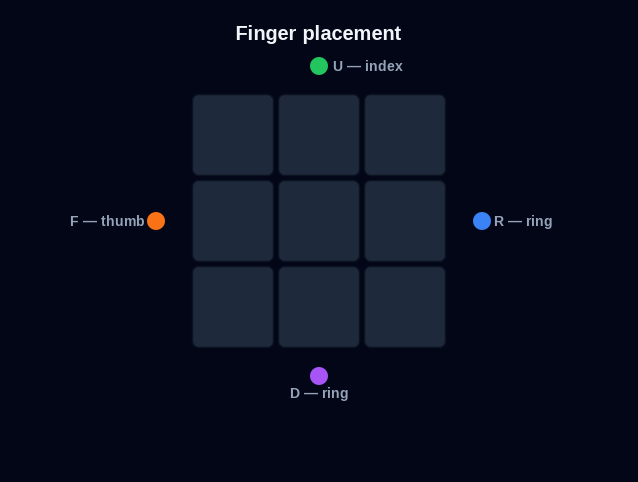
What changes with one hand
One-handed solving uses the same methods, but the ergonomics are completely different: you have five fingers instead of ten, and the cube rests on a table or in your palm.
The best OH cubers are usually only 1.5–2× slower than their two-handed times.
Grip and setup
- Hold the cube with the left hand if you solve with the right (most people do the opposite: right hand turns, left holds).
- Rest the cube on a table between turns to stabilise it.
- Keep the wrist straight; turn from the fingers.
Moves that work
| Move | One-handed comfort |
|---|---|
| R, R’, U, U’ | easy |
| R2, U2 | easy |
| F, F’ | awkward |
| D, B | very awkward |
Methods with few F and B moves dominate OH: ZZ and Roux are popular for exactly this reason.
Training
- Solve slowly with one hand, no timer.
- Use the same algorithms you already know; do not learn new ones at first.
- Add a light warm-up: wrist circles, finger stretches.
- Stop if your wrist hurts — it is a real injury risk.
Common mistakes
- Gripping too hard. Tension slows you down and tires the hand.
- Learning new algorithms immediately. Reuse the two-handed set first.
- Ignoring table use. The table is a legal and useful stabiliser.
- Long sessions without breaks. Tendinitis is common in OH.
Mini FAQ
Which hand should I use? Whatever feels natural; most people turn with the right hand.
Is OH allowed in competitions? Yes, it is an official WCA event.
How much slower is OH? Typically 1.5–2× the two-handed time.
Next: ZZ and Finger tricks.
Other methods
CFOP: the main speedcubing method How CFOP works, why it dominates speedcubing, what each stage costs in time, and what to learn in which order to reach sub-30 and beyond. Roux method A block-building method: two 1x2x3 blocks, CMLL corners and last-six-edges with M-slice moves. Why Roux needs fewer moves and rotations. ZZ method Edge orientation first: EOLine, a rotating-free F2L and a last layer with fewer cases. Strengths, costs and how to learn ZZ. Petrus method Building a 2x2x2 block, expanding to 2x2x3, fixing edges and finishing the last layer. The method that introduced block building to speedcubing.