How to solve a 5×5 Rubik's Cube
A 5x5 guide: 3x3 centres, pairing three-piece edges, the last two edges and the reduction to a 3x3. No parity on odd cubes.
How 5×5 differs from 4×4
The method is the same idea — reduction — but with two differences:
- Centres are 3×3, not 2×2: nine pieces per face instead of four.
- Edges are triples: three pieces form one edge (a “triple edge”), not two.
There is also no parity: odd cubes cannot produce the impossible states of 4×4 and 6×6.
Stage 1. Centres 3×3
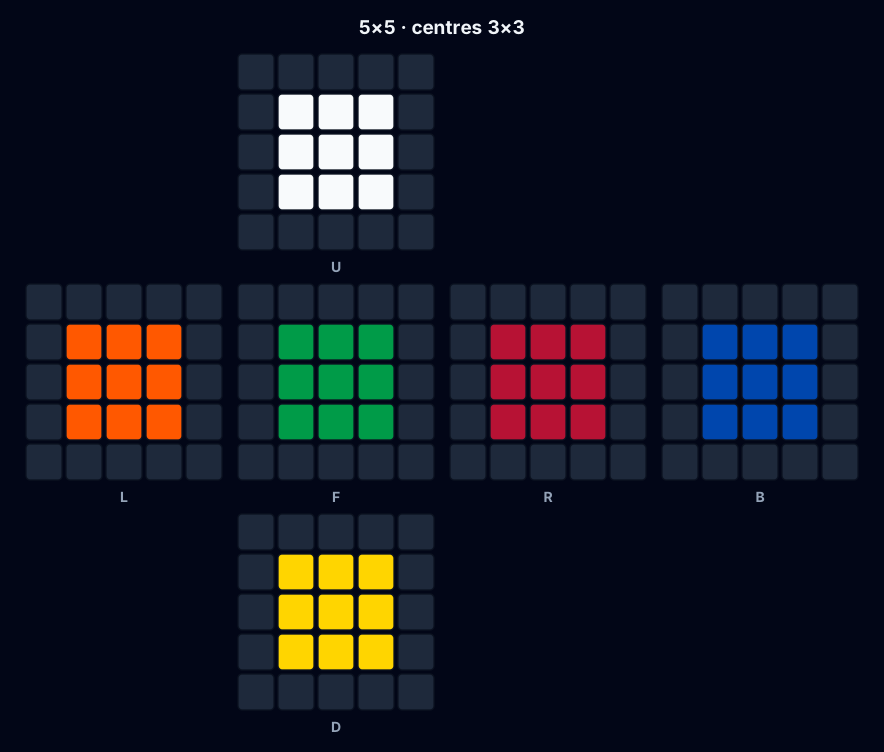
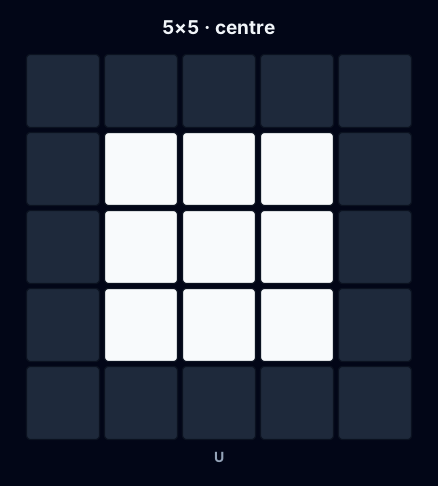
- Start with the white centre: build a 1×3 strip in the middle, then add the two side strips.
- Build the opposite centre (yellow). Keep white on top so yellow ends on the bottom.
- Build the remaining four centres strip by strip.
- Check the colour scheme: white opposite yellow, green opposite blue, red opposite orange.
The centre pieces of a 5×5 already fix the scheme, so mistakes are rare — but check anyway.
Stage 2. Pairing edges
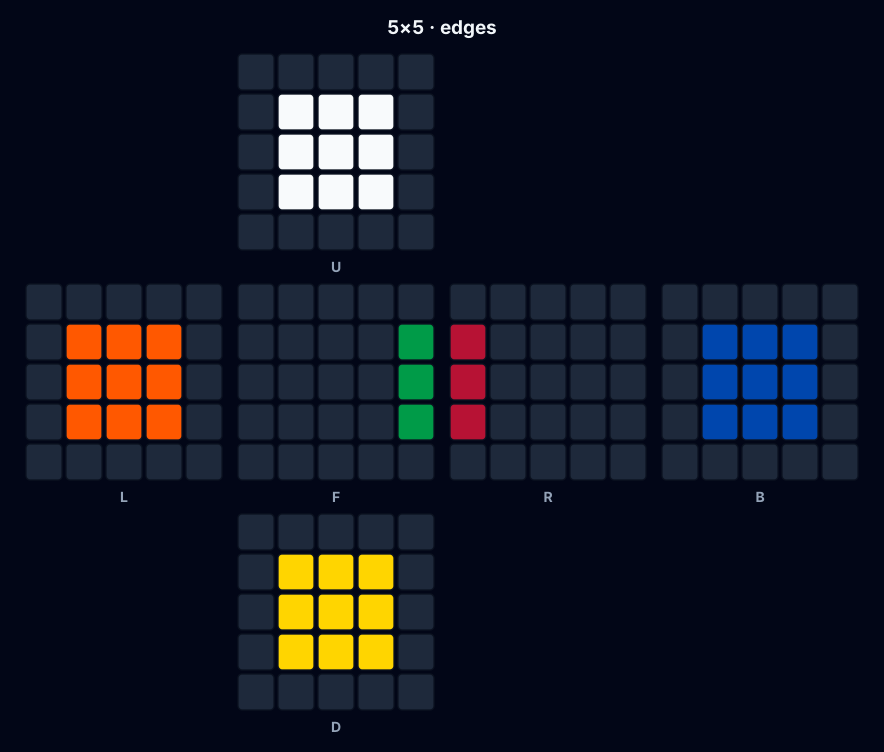
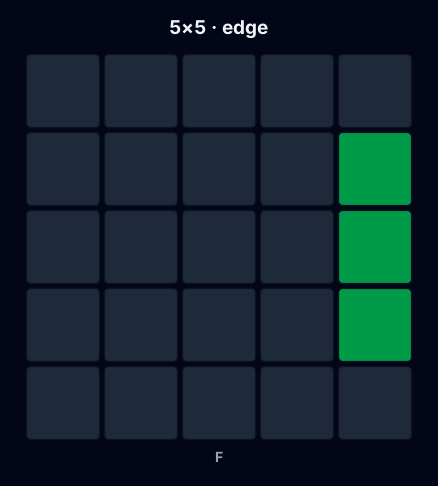
- Put two matching edge pieces side by side.
- Close the edge with the third piece using a wide turn.
- Restore the centres with the reverse wide turn.
- Repeat until all twelve edges are triples.
Keep paired edges out of the way, and do not worry that the centres shift a little — restore them before the last stage.
Stage 3. The last two edges
The classic 5×5 difficulty: two edges remain and both look flipped. This is not parity; a flip formula fixes it. It is the same algorithm used for 4×4 OLL parity:
Rw U2 x Rw U2 Rw U2 Rw' U2 Lw U2 Rw' U2 Rw U2 Rw' U2 Rw'
After that the edges sit correctly and you can solve as a 3×3.
Stage 4. Solve as a 3×3
With centres and triples done the cube behaves like a 3×3. Use any method:
Why there is no parity
Odd cubes have fixed centres and a single middle edge piece, so the parity states of 4×4 cannot occur. If something looks like parity on a 5×5, the cause is an edge-pairing mistake.
Common situations
| Situation | Cause | Fix |
|---|---|---|
| Centres drifted during edge pairing | Wide turns moved them | Restore with the reverse wide turn |
| Two edges look flipped | Last-two-edges case | Flip formula above |
| “Parity” on the last layer | Pairing mistake | Re-check all twelve edges |
| Cube does not behave like a 3×3 | Not all edges are triples | Finish edge pairing |
How long it takes
- First solve: 30–60 minutes.
- After ten solves: 10–15 minutes.
- Confident: 4–6 minutes.
Mini FAQ
Do I need 4×4 experience first? It helps, but the method is the same idea.
Are the centres hard? They are the longest stage; practice strips of three.
Can I use 4×4 parity formulas? Only the edge flip; the PLL parity formula does not apply.