ZZ method
Edge orientation first: EOLine, a rotating-free F2L and a last layer with fewer cases. Strengths, costs and how to learn ZZ.
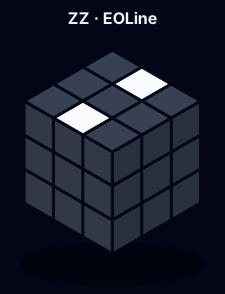
The idea
ZZ starts by orienting all edges and building a line on the bottom. Because every edge is already oriented, the rest of the solve needs no cube rotations and only L, R and U moves.
That makes the F2L smooth and the last layer smaller: with oriented edges, OLL shrinks to 7 cases (OCLL) and PLL to 21.
The stages
| Stage | What it does |
|---|---|
| EOLine | Orient all 12 edges and place the DF and DB edges |
| F2L | Two 1×2×3 blocks with R, L, U only |
| OCLL | Orient the last-layer corners (7 cases) |
| PLL | Permute the last layer (21 cases) |
Why ZZ is attractive
- No rotations after EOLine.
- Fewer algorithms for the last layer.
- Ergonomic moves: mostly R, U, L.
Why it is hard
- EOLine is the bottleneck. Planning it in inspection takes practice.
- Blocking F2L feels unusual after CFOP pairs.
- Less material than CFOP, though more than Roux.
Learning order
- EOLine — start with EO only, then add the line.
- F2L with R, L, U.
- OCLL — 7 cases.
- Full PLL.
ZZ or CFOP?
ZZ suits cubers who like planning and hate rotations. Its EOLine is a real skill barrier; most people who quit ZZ quit there.
Common mistakes
- Ignoring EO mistakes. A single misoriented edge breaks the whole premise.
- Rotating the cube. The point of ZZ is not rotating.
- Learning OCLL before EOLine is reliable. Fix the foundation first.
Mini FAQ
How many algorithms for ZZ? About 28 for a full solve (7 OCLL + 21 PLL).
Is ZZ slower than CFOP? Comparable; it depends on the solver.
Can I use ZZ one-handed? Yes — it is popular for OH because of the ergonomic moves.
Next: Roux and One-handed.