How to solve a Pyraminx
Pyraminx guide: notation, aligning the tips, solving one face and finishing the last layer with two short algorithms.
What a Pyraminx is
A Pyraminx is a tetrahedron with four triangular faces. It has:
- 4 tips that twist on their own,
- 6 edges,
- no centres in the usual sense.
It is one of the easiest puzzles to learn — most people solve it in a few minutes on the first try.
Notation
| Letter | Face |
|---|---|
R | Right face |
L | Left face |
U | Top face |
B | Back face |
A letter turns the two layers of that face; lowercase (r, l, u, b) turns only the tip.
Stage 1. Tips
Twist the four tips so their colours match the adjacent faces. This takes seconds and is skipped in competitions only when already aligned.
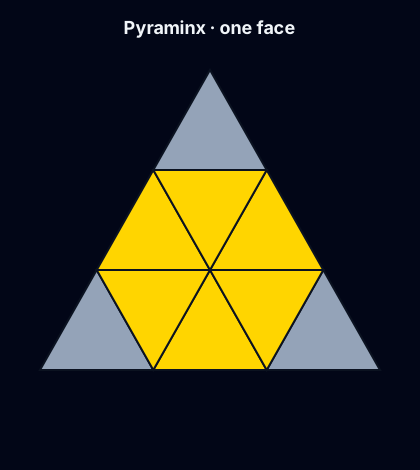
Stage 2. One face
- Pick a colour, for example yellow.
- Bring the three edges with yellow to the yellow face.
- The result is one solid face with matching side colours.
Work with the face pointing down for stability.
Stage 3. The last layer
With one face solved, the last three edges need a cycle:
R U R' U'Apply it while holding the unsolved edge at the front-right, then adjust with U and repeat. Two applications are usually enough.
If an edge is flipped, use:
R U R' U R U R'Stage 4. Check
- All four faces are one colour.
- Every tip matches its face.
Common mistakes
- Turning tips only. The main algorithm needs full face turns.
- Losing the solved face. Hold it down and turn only the top layers.
- Ignoring the last edge orientation. A flipped edge needs the second formula.
How long it takes
- First solve: 5–15 minutes.
- After practice: 10–20 seconds.
Mini FAQ
Is Pyraminx easier than 3×3? Yes, much.
Do I need algorithms? Two short ones are enough.
Is it a WCA event? Yes, with single and average formats.