How to solve a Skewb
Skewb guide: notation, solving the first face, the sledgehammer for the last corners and the centre pieces that confuse beginners.
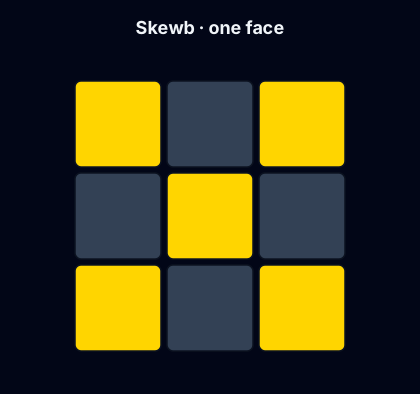
What a Skewb is
A Skewb turns around its corners, not its faces. It has:
- 8 corners (with three stickers each),
- 6 centres (one sticker each, they move!),
- four axes of rotation.
That combination is why a Skewb feels unlike a cube: the centres travel with the corners.
Notation
| Letter | Turn |
|---|---|
R | Right corner block, clockwise |
L | Left corner block |
U | Top corner block |
B | Back corner block |
A prime turns the same block counter-clockwise.
Stage 1. First face
- Pick a colour, for example white.
- Bring the four white corners around the white centre.
- Check the sides: the side colours of those corners must match the adjacent centres.
The result is a solid white face with a matching ring — not just white stickers.
Stage 2. Last four corners
Turn the cube so the unsolved corners are on top. Use the sledgehammer:
R' F R F'Apply it while holding a solved corner at the front-right and adjust with U between applications. The top corners will fall into place.
Stage 3. Centres
Centres often look wrong while the corners are right. If a centre is in the wrong place, apply a sledgehammer to cycle it, then re-solve the corners.
Common mistakes
- Treating it like a 3×3. Face turns do not exist here.
- Ignoring centres. They move and must match after the corners.
- Solving corners without the ring. A white face with mismatched sides is not a solved layer.
How long it takes
- First solve: 10–20 minutes.
- After practice: 5–15 seconds.
Mini FAQ
Is Skewb easier than 3×3? Similar difficulty, different logic.
How many algorithms? One sledgehammer plus a centre fix is enough to start.
Is it a WCA event? Yes.