How to solve a 4×4 Rubik's Cube
A detailed 4×4 guide: building centres, pairing edges, reducing to 3×3, and both parities with formulas. Plus why each stage works.
How 4×4 differs from 3×3
On a 3×3 the centres are fixed, so you just build layers. On a 4×4 the centres move, and there are 24 edges instead of 12 — two identical pieces per slot. So the solve happens in two big phases:
- Reduction — turn the 4×4 into a “big 3×3” by building centres and pairing edges into double edges (dedges).
- 3×3 stage — the cube now behaves like a normal 3×3, except for parities: situations that cannot happen on a 3×3.
There are two parities: OLL parity (one edge flipped) and PLL parity (two edges swapped). Each has its own formula.
Notation
4×4 adds wide turns — two layers at once:
| Notation | Meaning |
|---|---|
R, U, F, L, D, B | A normal face turn, as on 3×3 |
Rw (or r) | Turn the two right layers |
Uw (or u) | Turn the two top layers |
r2 | Both right layers, 180° |
Directions and primes work as on 3×3. See the notation reference if needed.
Stage 1. Centres
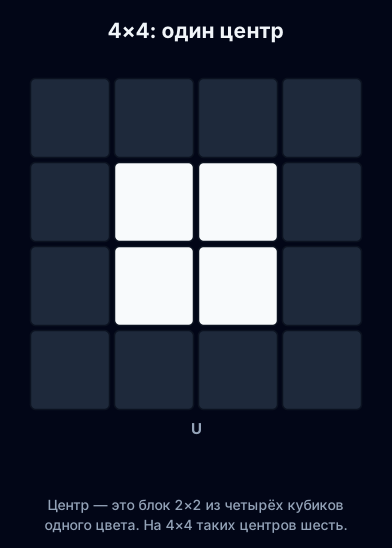
The goal is six 2×2 blocks in the middle of each face.

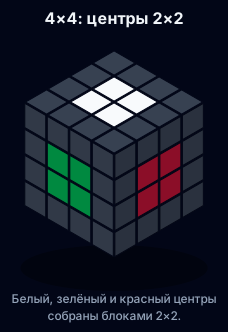
- Work out the colour scheme. Look at the corners: white is opposite yellow, green opposite blue, red opposite orange. Do not change these pairs.
- Build the first centre. Collect four pieces of one colour into a 2×2 block. Start with white.
- Build the opposite centre (yellow). Keep white on top; yellow should end up on the bottom.
- Build the remaining four centres. A useful trick: build a 1×2 bar, then a second bar, and join them with one face turn.
- Check: six 2×2 blocks, opposite colours really opposite.
You can turn any face while building centres — nothing else is solved yet.
Stage 2. Pairing edges
Now pair identical edges into dedges. There are 12.
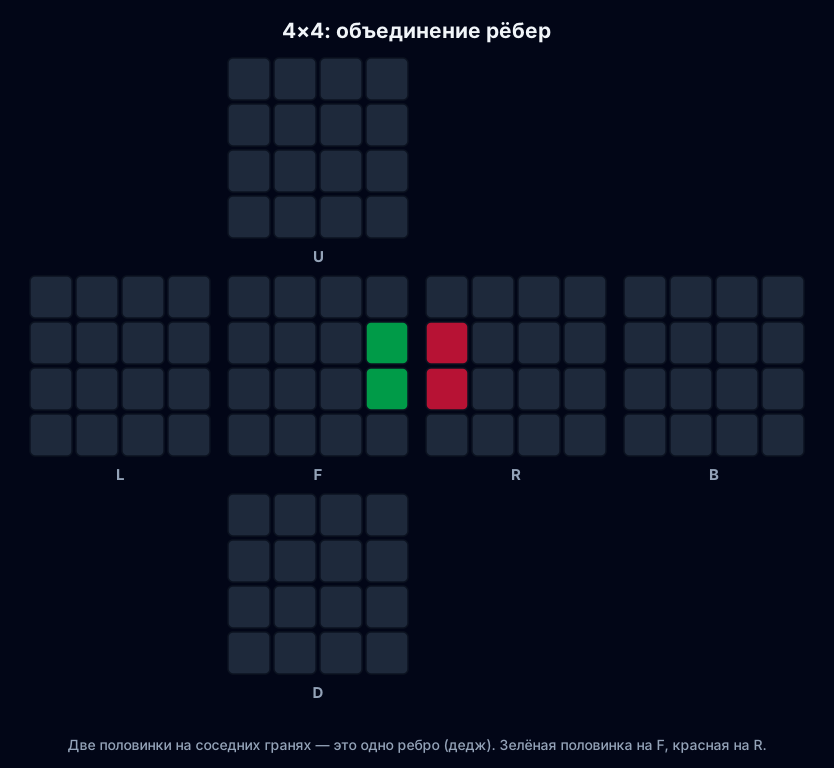
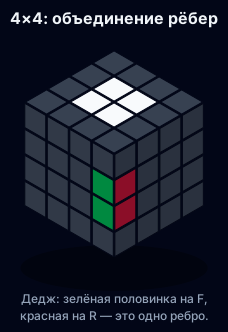
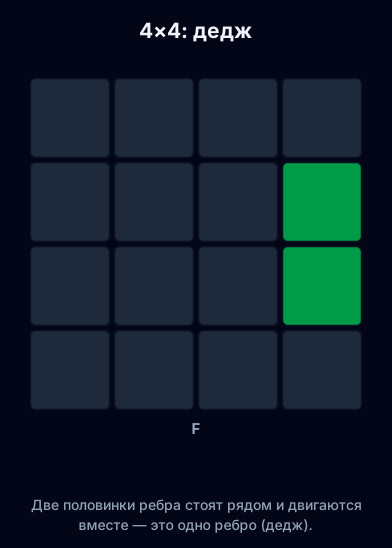
- Find two edge pieces with the same colours (green-red, for example).
- Put them on the same face but in different layers — one closer, one further.
- Join them with a wide turn (
Uw,Rw, …). The centres will shift; that is normal. - Restore the centres with the reverse wide turn.
- Repeat until all 12 dedges are complete.
Keep in mind:
- Do not break paired edges. Pair one at a time and park finished ones out of the way.
- The last two edges sometimes need a flip formula. If the halves are in the right place but flipped, use the edge-flip formula (the same one as OLL parity).
- Check: every dedge has two matching stickers side by side.
Stage 3. Solve as a 3×3
With centres and edges done, the cube behaves like a 3×3. Use any method:
- Beginner method — 7 steps.
- CFOP — faster, more algorithms.
If you already solve 3×3, this stage is quick.
Stage 4. OLL parity
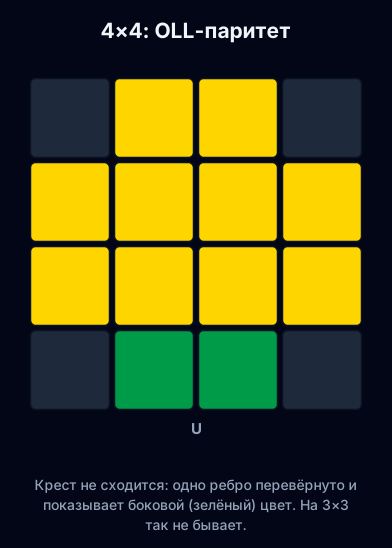
Symptom: the last-layer cross will not form — one edge is flipped. Impossible on 3×3.
Formula (classic notation with a cube rotation):
Rw U2 x Rw U2 Rw U2 Rw' U2 Lw U2 Rw' U2 Rw U2 Rw' U2 Rw'Alternative without rotation:
r2 B2 U2 l U2 r' U2 r U2 F2 r F2 l' B2 r2After that the cross forms and you continue as on 3×3.
Stage 5. PLL parity
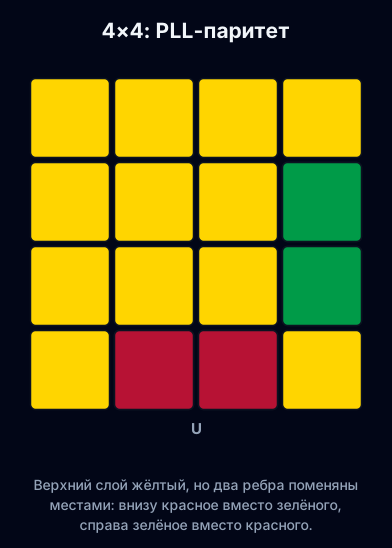
Symptom: cross and corners are correct, but two last-layer edges are swapped. Also impossible on 3×3.
Formula:
r2 U2 r2 Uw2 r2 Uw2It swaps two dedges. Then finish with normal PLL (or the beginner method).
Common situations
| Situation | Cause | What to do |
|---|---|---|
| Centres built, opposite colours swapped | Wrong colour scheme | Rebuild centres using the corners |
| One edge flipped on the last layer | OLL parity | OLL parity formula |
| Two edges swapped | PLL parity | PLL parity formula |
| Edges will not pair | Halves are in different layers | Put them on one face in different layers and use a wide turn |
| Cube does not behave like a 3×3 | Not all dedges are complete | Check all 12 edges |
How long it takes
- First solve — 20–40 minutes.
- After 10 solves — 5–10 minutes.
- Confident — 2–4 minutes.
- Speedcubing — 40–70 seconds.